
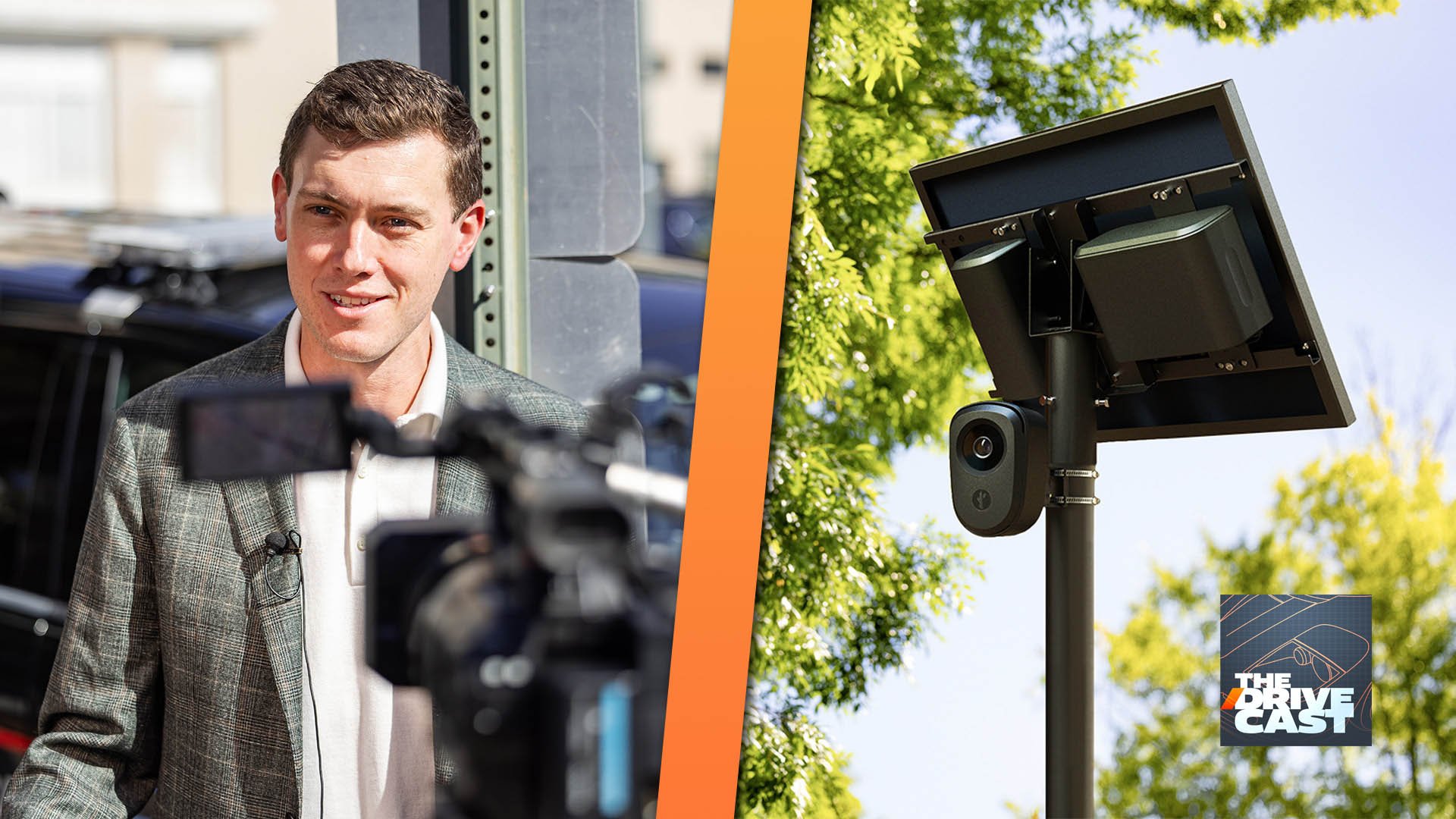
Millions of people have seen the story of Flock cameras tracking me in a $155,000 Range Rover and subsequently four police officers surrounding my wife and me in a parking lot. Human error was involved, but Flock cameras working off the company’s AI tech compounded everything at an exponential rate.
Now on the latest episode of The Drivecast, Flock Safety Founder and CEO Garrett Langley sat down with me for a candid discussion about what happened to me and countless others in the last few years, the future vision for Flock amid the public backlash over privacy and Fourth Amendment concerns, the growing calls for regulation, and his previous comment that people who destroy or vandalize Flock equipment are “domestic terrorists.”
On a daily basis there’s reporting of cops misusing Flock’s tech to stalk people, which in turn ends up getting them arrested and sent to jail, misread situations taking place, arguments at city council meetings, and people targeting the automatic license plate readers and cutting them down, shooting them, covering them with trash bags and more. You might call this a hot topic, and somehow, I landed right in the middle of it.
New here? The Drivecast is The Drive‘s weekly podcast that takes you behind-the-scenes on the largest controversies, stories, and characters shaping the automotive industry along with the way our roads look today. Powered by The Drive‘s inside access, original reporting, exclusives, and insights, The Drivecast aims to make everyone an insider.
Listen to The Drivecast via Spotify, Apple Podcasts, or Amazon Music. Love it? Like it? Want to help? Leave a five-star review on your platform of choice to help get The Drivecast in front of more people. Have a suggestion, tip, request, or feedback? Drop us a line at feedback@thedrive.com. I promise, we read every single email.
Full Transcript
Joel: Garrett, thank you for agreeing to come on the podcast. I know you’re extremely busy and there’s a lot of controversy at the moment surrounding Flock. You’re living your life on an airplane, even though you’re a family man. Just to get it out of the way and start, aside from a thank you, typically every executive we’ve had on this podcast, I kind of know them. I’ve worked in the industry for 15 years, so I usually know them, we’ve had a relationship. This is the first time I’ve ever met you. Given the podcast and everything, I have to ask: Are you a car enthusiast? Do you like cars? Do you care about driving? I’m genuinely curious.
Garrett: I hate to spoil it for your fans. I am not a car guy. Now, I have a deep appreciation for F1, and that’s more from an athletic standpoint. You look at the sheer engineering behind it—they’re optimizing every single millisecond, every single millimeter of the engine and of the design. But funny enough, up until two or three years ago, I was driving the same Toyota Prius that I’ve been driving since college. Everyone was like, “Why don’t you drive another car?” It works. It works really well. Gets me from A to B. It’s a great car. I wound up upgrading the dash to have Apple CarPlay, because the Toyota didn’t have it, so I retrofit that myself. But no, I get a hard time from some of my friends who love cars, saying that I should be more into cars. Between three kids, a wife, and a business, I’m trying to find time for the simpler things in life.
Joel: I can appreciate that. I didn’t really know what you were going to answer, because the reality is that you’re not a car company, you’re not a supplier of car parts or any of that stuff, so I think it was just context. By the way, a Prius, a Corolla, a Camry—there’s nothing really wrong with them. They’re not enthusiast cars, but to your point, if you’re looking for fuel-efficient, safe, reliable, get you from point A to point B, it’s hard to beat, specifically a Prius. The most recent one looks awesome.
Obviously, I have 99 million questions. There is zero chance we could ever cover all the topics today in the short period of time that you and I have together. I have to start with my situation, because that’s how we got here. There’s no way we could not discuss this. I don’t want to sit and belabor anything. You’ve read the stories, I’m sure you’re up to speed on what happened. I’ve written the stories, I’m well-versed with what happened. I’ve spent countless hours on the phone with your Chief Communications Officer, Josh—super nice guy.
As a recap, if you’re one of the millions of people that did not read the story or hear the podcast, a human error led to a police officer entering incorrectly an incomplete plate number into the National Crime Information Center database. That is managed by the FBI; that’s what all the police from across the nation pull from. That is also what gets fed into automatic license plate readers. Whether it’s Flock, Leonardo, or Axon, Garrett’s team doesn’t have its own database; they’re pulling from the FBI Criminal National Information Center database.
They were fed bad, partial, incorrect information. The system was told, “Go look for a license plate of 34DTM.” It was told to do that. It found it, but the problem was that the one it found—the one on my press car that week, a $155,000 Range Rover—also had a ’10’ in there. Flock saw it, the system saw it. It wasn’t asked about a ’10’, it wasn’t programmed to care about a ’10’, it was programmed to find the bone that it was asked to find. It did, and basically it fed it to the police. The local police then didn’t do the back-end loop, and they did not cross-check the actual plate. There was a photo of the plate, I saw it, they showed it to me, it had ’10’ on it. They either didn’t know what to do with it, they disregarded it, they didn’t enter it into the system. They looked at my plate, they didn’t understand the ’10’, and then they looked at my plate and thought I performed Grand Theft Auto, which I did not.
Basically, we had human error that led into Flock as a technology exponentially increasing the rate at which that error spread, but it wasn’t the source of the error. Then human error on the back end of that loop, not cross-referencing it. A compounding amount of issues at hand.
You can’t change human error; that’s not your job. What I am curious about is, I know Josh mentioned you guys talked to the FBI who manages NCIC, and he tried to talk to the LA police that entered the incorrect information. I’m curious from this situation: What will Flock as a company take away, what have they learned, and what changes will we learn from my edge case? We learn from edge cases.
Garrett: One, I appreciate you sharing and hitting on the facts, which is that there were a lot of things that went wrong. It’s easy to potentially try to aggregate that down to “Flock did this,” and a lot of mistakes happened to create this edge case. Sadly, you weren’t the first person who’s had an edge case, and to your point, Joel, the biggest issue remains this national database at the FBI called NCIC, and how archaic its structure is. There’s no feedback loop mechanisms; it’s really just a static comma-separated file.
We’ve tried to build around it. We have this concept called “suppression.” A local agency—let’s take Atlanta, where I live—might see that there’s a stolen plate out of California, but it’s already been resolved because it’s a rental car or a dealer car. They can, in Flock, suppress that: “Never alert us on that for the next year.” That’s to get around the fact that they can’t force another agency to remove it from NCIC.
Ideally, the way it would work is if enough agencies—let’s call it one, two, or three—flag a tag as no longer valid or a bad entry, it should just get removed. Or at least it should get pushed more aggressively by the FBI. For us, we maintain a productive relationship with the FBI. They obviously play a critical role in broader public safety, and I’m hopeful that they’ll see there’s an opportunity to make something like NCIC, which is an important tool not just for companies like Flock, but for police departments to work together, start to make some enhancements to modernize what’s a central part of our policing system.
Joel: I’m curious because you said something I hadn’t heard yet, whether talking to the chief of police or Josh. When my situation occurred, one of the things I learned from my local police that this all went down with is they asked me where I was going to drive the car, if I was going to drive to other suburbs. I said yes. They warned me that other police officers might be trained differently—Minneapolis might be more aggressive, they might show up with guns drawn, which mine didn’t.
They warned me that I have the case number and my police officer’s name that went through everything with me, and they’re like, “In Plymouth, you have a safety net now; you’re not going to get flagged. But if you go into another suburb with Flock, it’s going to flag you again because it’s pulling from the NCIC.” If Plymouth had done the suppression thing you just mentioned, that doesn’t translate to the Minneapolis Police Department.
Garrett: No, it only impacts Plymouth, because we don’t necessarily want to make a decision on behalf of Minneapolis or Los Angeles. We very much have this structural viewpoint that local decisions should stay local. Plymouth made a decision to suppress that, that’s their right to do that, but that doesn’t impact Minneapolis’s setup.
Joel: Do you believe that in this situation, Plymouth police quickly realized—”quickly” is a relative term in the scheme of life—in the scheme of that day, my wife will tell you so, but do you think that, to your point about the NCIC database, Plymouth police told me the only ones in the situation that could have updated that partial plate in the system would be the officer’s unit? In this case, it was the LA Sheriff’s Department, Malibu Lost Hills station. They’re the only ones that can update that issue. Do you think that as you are talking with NCIC and the FBI about how to modernize the system, it should be able to allow Plymouth police, if they run this down and talk to LA and figure out the situation, to correct this? We shouldn’t have to have this weird loop of Jaguar having to call LA.
Garrett: A proposed solution would be one where—let’s make it you and me so it’s easier and fewer words. Garrett puts in a tag “FEDER” as a stolen car. If Joel says, “Wait a second, I just pulled that person over, that’s not valid anymore,” you should have the ability to say, “I think this should be removed.”
Then to me, I should have some clock—called a day, a week—to say, “No, Joel, you are wrong, I want to keep this.” That to me makes a lot more sense, where you have the ability to say, “Hey, I should delete this,” and I go, “Okay, well I can either let it disappear because I’m not going to fight it, or I could choose to say there’s a reason why that you might have misunderstood.”
I agree with you, there needs to be more collaboration. That’s how more modern systems work. Similarly on our side, I think to your point…
Joel: To be clear, in this situation where I’m Feder and you’re Garrett with the license, are you talking about you as Flock, or you as the FBI NCIC?
Garrett: Us as police departments. Let’s make it easier: I’m LA County, I enter in FEDER as this stolen car. You’re Plymouth and you’re like, “I don’t think it’s stolen anymore, this looks normal.” You should be able to say, “I think it needs to be deleted.” As LA County, I should have a day or a week to say, “No, it is really stolen,” or it automatically gets deleted and removed from the list.
Inevitably what happens is, let’s take the rental car example: A car is reported stolen by the rental car agency. I’m LA County and I put it in NCIC. But then, low and behold, the car was returned a month later. It was not stolen, someone just forgot to return it or something. To me, there’s either an expiration—if you look at the way the Flock system works, which is a little bit different than NCIC, we require an expiration period. You can’t just put something into a list forever. It either is going to be there for 7 days, 30 days, 90 days—you have to define this expiration. I think that would also be a meaningful and positive change to NCIC, to have a 7-day or 30-day max expiration period so that you don’t wind up with this stale data in the system like you experienced.
Joel: Last question on this topic. Flock has an expiration, but NCIC doesn’t. So in this case, let’s make believe in some timeline that didn’t happen and my wife got a manicure that day. She would have been much happier. If 34DTM had been in the system and not gotten pulled over, you’re pulling from NCIC, it wasn’t in the Flock database. You said there are expirations, it can’t be searching forever. How does that work if it’s not expiring out of the NCIC?
Garrett: Here’s a good example: Let’s take Plymouth. Let’s say Plymouth has reasonable suspicion that Feder’s license plate was associated with a residential burglary. They could create on their local version a hot list entry to say, “Hey, this is our Plymouth-only hot list.” There’s NCIC, and we force an expiration on the local level. I think it would be great if NCIC had a similar expiration requirement of, let’s call it a week or a month, so that as a criminal investigator, every month you have to reconfirm, “Yes, I am still looking for this car, it is still an active investigation.” I think that would help a lot. It puts more onus on law enforcement, but your story is a prime one of why the extra work by the law enforcement agency is worth it. It’s not that much work relative to your experience.
Joel: Got it. Let’s pivot from my experience into the future of here and now, and where we go from here, but staying on my topic a little as a joiner setup.
Josh made mention—and it’s all over your website—that there’s a 99% success rate. I don’t want to sit here and question that, so let’s use that in this scenario. You guys are doing about—these are round numbers to be clear, because they’re big—20 billion reads a month. 20 billion reads a month and a 99% success rate means there’s a 1% error rate, misread rate, call it whatever you want to call it. 1% of 20 billion, which is a huge number, is a huge number. I was one of them. Now, I wasn’t a misread, to be clear, but it was an error situation with a bad outcome that ended up with an outcome we don’t want.
What exactly are we doing, what’s Flock doing, what’s being done to bring down that 1% error rate so we’re not at 200 million? Which sounds like an immense number—not an immense number when you have 20 billion, but it’s still a big number.
Garrett: Your experience wasn’t even a misread; that’s a flaw in the error. The math you used—we don’t need to debate it, but what I would articulate is that doesn’t express the false positive rate, which is actually what you should be worried about. A false positive rate would say we read a license plate, FEDER, we’re confident it’s FEDER, and it’s stolen according to NCIC, so we send an alert.
It’s not just a function of how accurate we are, but how confident in our accuracy. There’s an important detail in how the system works, because technology will never be perfect, just like human eyes aren’t perfect. The question is what redundancies and what guardrails are you building into the system to prevent and reduce the likelihood of something bad happening.
In our case, let’s say it’s FEDER, and we’re 99% confident it’s an F, 99% on an E, 99% on a D, 99% on an E, and we’re only 80% confident that R is an R. We don’t send the alert.
Joel: Is that how it’s set up today?
Garrett: Yes, that’s how it works today. That’s an important detail because we will save that image, and we will store that under a certain confidence interval, but there is a very high bar for us to notify a local law enforcement officer in their MDT, in their patrol vehicle, of an NCIC alert. We have to be very confident, because even though we do the training and say you need to human verify this, and even though we do the training and say you need to double-check NCIC that there’s an active warrant, even though we do all that training, we know that humans are going to make mistakes.
We know that for many people, myself and yourself included, being pulled over by an officer is scary. It is. I’ve been pulled over before, I’ve sped, it happens. It’s scary, your heart races. We want to put that at a 0% likelihood that there is a wrongful traffic stop.
Joel: What’s the threshold? You said 80%, 99%. What’s the threshold that it has to be?
Garrett: I don’t think the number matters as much, because if I told you it’s 50%, you’d say, “What does that mean?” Here’s a way to think about it: It’s less than one in a million alerts that an officer says, “I’m not sure if that’s right.” Less than one in a million. To me, it’s incredibly low. Now, should it be one in a billion? Sure, that’s an interesting tradeoff.
For me, to your point, I want the OCR or the character recognition to be as good as possible. I would argue we have the best license plate reading camera in the world. We definitely are the largest provider of it in the world, so we probably have the best. For me, I think we’ve built these multiple redundancies to prevent—your situation is hard because I can’t control NCIC. What I can control is a wrongful traffic stop due to an OCR misread, and that I think we do have a lot of control over.
Joel: That’s a great transition to some broader questions about where we are today, what’s happening, and where we go in the future. I’d like to start with the future. You’re the man behind Flock. You founded it, you’re in charge of it, you’re the CEO. What is your vision for the future?
For context, I live in Plymouth, Minnesota. There are 18 cameras in Plymouth right now; that’s not every street corner today. Now, there are cities that have a lot more than that, and cities that have a lot less. My question is, what’s your vision for the future? Is there a Flock camera on every street corner, in every school? I know you guys are introducing new technology that’s not just cameras on top of streetlights. What’s your vision for the future, where are we going?
Garrett: One, thank you for the chance to talk about this, because I’ve spent the last decade of my life thinking about this. Just like you, I’m a father of three kids. My primary objective as a father is to keep them safe. They’ve got to be safe. Then I’ve got to make sure they’re educated, that they’re good people, productive members of society. But if they’re not safe, everything else starts to crumble. I think that’s true for a lot of kids. That lack of feeling safe starts to lead to these erosions of society.
If I zoom all the way out, we’ve always thought about crime and safety in two big buckets. You’ve got one bucket, which is emotional crime—crimes of passion. I hate to say it, we’re not going to stop those. They’ve been around for thousands of years. However long humans have been around, we have unfortunately been having passionate crimes, which is horrible. So we’ve got to solve those, but we’re not going to stop them.
The opportunistic crime, though—that’s actually very controllable. The majority of crime, let’s call it 95% to 99% of crime, is truly opportunistic. “I walk by your car, I believe I can get away with stealing it, so I choose to steal it.” That is the thought process.
What we’ve noticed is in certain places like San Francisco, four years ago, you could get away with almost any crime. Then two or three years ago, Mayor Breed and Mayor Lurie said, “Flock, we need help. It’s too easy to be a criminal, and our businesses are leaving, our people are leaving. This isn’t working for us.”
We deployed hundreds of license plate readers, we deployed our drones, we deployed our real-time crime center software to make officers more efficient. Now it’s one of the safest cities in America. Mayor Lurie has one of the highest approval ratings of any major city mayor—he might actually have the highest, last I checked.
For me, the future is a future where more cities look like San Francisco, where crime is incredibly hard to get away with—so hard that people just choose not to do it. That might seem like a distant future, but it’s happening in San Francisco. I think we’re going to do the same thing in Oakland. We’re in 7,000 cities today, and I’d like to get us to all 17,000 cities in America and create that future, because it’s quite doable. Whatever technology we need to build to help get there while maintaining our local societal norms is what we’re planning to do. That might sound crazy, but I said it 10 years ago, and now it’s really happening at scale. It’s a pretty exciting time.
Joel: Societal norms—you mentioned that. I want to be very clear, we’re not a political podcast, that’s not where we’re going to go, and I don’t really want to get into that here on the podcast. But societal norms—at one end of the spectrum, we’ve got people that are like, “If we have these on every corner, we’re going to have a dragnet map of your life without a warrant, and a Fourth Amendment violation.” Where do you fall on this whole topic of where Flock sits today, where the company sits tomorrow as you expand, and the warrantless Fourth Amendment concern—people’s concern of you doing a digital map of their entire life without a warrant?
Garrett: People tend to have three concerns or three questions about the company: privacy, constitutionality, and accountability.
You mentioned the constitutional one. That one’s pretty cut and dry. You and I don’t get to pick what’s a constitutional violation and what’s not. We have judges, we have elected officials, there’s a process for that. We follow the law, we follow the Constitution. So far, in our belief and what will be for a long time, the courts have deemed this is not a warrantless search; this is a valid product as it relates to the Fourth Amendment. So I don’t see any change there.
On the privacy one, though, there’s some real questions that we ask as well. Here’s a good example: Before I started Flock, this type of ALPR data was stored in perpetuity. It was resold for commercial purposes by repo trucks to insurance providers. It was pretty nasty, in my opinion. We were one of the first companies to say there’s going to be a 30-day default retention, and we aren’t going to sell the data.
I’ll tell you an interesting stat: We solved just over a million crimes last year on the Flock system in partnership with local law enforcement. If I told you that if we reduce the 30-day retention to 14 days, 30% fewer crimes would be solved—so roughly 300,000 more victims without justice—would you make that tradeoff?
Before you answer—I won’t make you answer that one on the spot—my point would be you and I shouldn’t pick. Actually, the Mayor of Plymouth and the City Council should make that decision, because that’s a fair tradeoff. We elect people who we believe match our values to make these very difficult, non-black-and-white questions. There’s no answer there, because you could go down with something like Flock and say, “We like the idea of Flock, but we only want to focus on Amber Alerts and Silver Alerts.” So there’s zero retention of the data, just alerts. I’d say, “Okay, you’re going to get about 50% of the value of the system, but if that’s what you want in Plymouth, great, we’d love to help you, but you’re still going to be safer.” Now, you’re going to be less safe than San Francisco, but that’s an option.
For us, we don’t want to push our opinion as individual citizens. I live in Atlanta, you live in Plymouth. We just wish that more elected officials would do their research, do their homework, form an opinion, engage the community, and then set a standard that makes sense for them.
Joel: Let’s go down the elected officials route; this was actually one of my questions. I’ve seen Congress members—not one, not two, a couple of them now—post on Instagram about introducing bills that would withhold federal funding from municipalities that would use Flock. I’m curious what you make of that. None of these, by the way, to my knowledge, have been introduced as of the time of this recording; they’ve all just been discussions, but they’re being thrown out there. It is being talked about.
Garrett: At the highest level, nothing would make me happier than if we had state-by-state regulation on this type of technology. That to me is so crystal clear, because the lack of regulation on this type of technology just shows that our elected officials need to move faster than they have historically. I’m not the first person to say that. That’s the case with technology in general, where we just tend to build and innovate as a country faster than we can regulate. That’s generally okay, but in this case, they’re behind.
The proposition of federal defunding of roughly, in this case, 80% of police departments because they use technology to keep their community safe is completely… I don’t know how that’s logical to people when there are so many better alternatives to regulation.
I think that there is a very low likelihood that anyone is that irresponsible to even propose such legislation. When it has been discussed in the past—which was about six months ago—it barely made it out of someone’s mouth before it was killed. I would just challenge those Congress folks, men and women, instead of being critical of the men and women who work tirelessly to keep us safe and the tools they need to be effective, maybe we should actually just talk about what guardrails are necessary for everyone to feel good about what’s required.
To me—and Joel, I don’t know if you agree, I hope you do—I think it’s crazy that in America today, there’s a 50/50 chance of getting away with homicide. That seems completely unacceptable as a society. Banning tools that allow us to drive clearance rates higher…
I say this because in Atlanta, where I live, there was a woman who was violently murdered in the middle of the night in Piedmont Park, our biggest park, five years ago, and that case is still cold. You know why? Because even though there were cameras, the cameras weren’t working. If those cameras were working, that woman’s family would have justice. They don’t today, and I think that’s horrible. We should not be comfortable with that as a society, and I know in Atlanta we are not.
Joel: We talked about Congressmen and elected politicians. I have to get your viewpoint on what you make of the public pushback, or towns canceling contracts, or not renewing contracts. By the way, I want to be clear on the podcast, I actually felt there was a lot of miss and/or shoddy reporting on a couple of the towns that “canceled” contracts, because they actually were set to expire and didn’t get renewed, and I dug into that. As a journalist, it irked me. But that’s not the point.
I am curious, what’s your viewpoint on the public pushback, towns either canceling or not renewing contracts? Flock’s not something that people use; it’s not something I use. It’s not something I’m opting into like iCloud or whatever, it’s something you have to accept, because you’re driving down the road and I didn’t opt into it like I do with my AirPods or my phone. I’m guessing that’s kind of some of the public pushback here when we were talking about the whole map and dragnet. We discussed your take on that, but I’m curious about your viewpoint on this public pushback and towns canceling or not renewing contracts.
Garrett: It’s a really interesting phenomenon, because in most businesses—I’ll take the case of your business—if one of your advertisers or one of your partners chooses not to renew, it’s not a headline. When you add a new advertiser, it’s not a headline. It’s been interesting because we’ve added probably 10 times the number of customers that are new than who have not renewed their service in the last 90 days, but you won’t read that in the headlines, right? Because it’s not an interesting story to say, “Oh, this city adopted Flock.” It’s only interesting to say, “This city has paused their service” or canceled it.
What’s also interesting to me is the media hasn’t reported on the dozens of agencies who paused their service, saw crime go up, and have now turned them back on. It’s just interesting. I don’t know why, but to your point, some are turning it off, and that’s their choice. What they will find is they will be less safe, and then they will call us back, whether it’s in a week, 30 days, or a year. We have a demonstrable impact on public safety, and some cities have tried the experiment and it fails, and they have an obligation to keep their citizens safe.
Joel: Final question before we go into a hot round of however long we have left: You’re a private company, and you’re the middleman between the public and the government. You’re helping the police, but you’re not a supplier, you’re a service. You’re selling a service, it’s a SaaS. It’s a subscription service, and if they stop paying, like we just discussed, you turn it off; they no longer have access to the service. But it’s a service to the government, but you’re serving the government in between the public, because you’re taking pictures of the public’s license plates or whoever’s running through, and then it’s going to the government. You’re not a government-owned entity. It’s not a common place thing in this type of situation.
Garrett: This is a really interesting question, so it gives me a chance to hit on a few points. One, and this has been misreported as well—hopefully you can help me get this word out—we do not own the data, the government owns the data. We don’t have access to it. We are the custodian, and the reason why we did this goes back to my example.
We got questions from our customers like, “We’re used to just buying equipment.” I said, “Well, how’s that going for you? Are you experts in camera installation, camera maintenance?” My Atlanta example before is a prime example of what happens when we ask our government to do too much. Law enforcement is really good at one thing, which is hopefully solving crime. That’s what we ask them to do. They’re not necessarily good at building cameras, designing cameras.
It’s important to know our customer owns the data. I would actually agree with you, one of the hardest parts about building this business is that the last company to go public in this space was 25 years ago. That’s not every measure for success by any means—you can build a great business that doesn’t go public—but when you think about other industries that have seen the sheer benefit of technology, we’ve left behind local government. No one wants to service local government.
This is one of the reasons why, as you and I talked about, this is a controversial company. I appreciate that. We are not setting up the next generation of entrepreneurs to get excited about working with local government when, honestly, they need more innovation, local government needs more technology. It’s hard, it’s really hard, but I think it’s worth it.
Joel: Let me ask you—Josh and I, if anyone’s cutting in now and hasn’t heard this, Josh is the Chief Communications Officer I talked to, and he’s been in a couple of our stories—he did make a mention of something you just noted, that you guys don’t own the data, it’s stored on AWS (Amazon Web Services), and that it’s bucketed by municipalities, and certain municipalities can have sharing with other municipalities.
We see in the news countless examples of whether it’s in Texas, or your home area, Georgia—bad actors, bad police misusing your system, stalking women, stalking ex-girlfriends and their family members, checking a certain license plate 179 times in a certain period of time, etc. Obviously, there are audit logs—Josh told me about this and this is how people get caught with audit logs.
I am curious, do you guys have multi-factor authentication? The reason I ask this is because even my iCloud and my Meta accounts have multi-factor authentication, and it makes it easier to track who that actual person is in the audit log and the audit trail to get caught. Does that make sense?
Garrett: Yes, so let’s hit on a few of these. As a matter of fact, we do. We do require multi-factor authentication, which is a step in the right direction. We’ve had that for years. Now, we used to not require it, it used to be optional, and the main reason why being if you’re a town of 10 sworn officers, you’re unlikely to be offering both a laptop and a mobile device that are government-issued. To do proper multi-factor authentication, you need to have multiple devices.
We’ve evolved our thinking and said any version of MFA is better than no MFA, so we will just mandate it now, which we’ve now done.
To your point on auditability and accountability, yeah, I actually think this is a problem more broadly in law enforcement—that we’re one of the only systems that actually has auditing and has abnormal behavior detection in it. All these cases you see happening are because our system is flagging, “That’s pretty weird.” It’s not necessarily illegal—innocent until proven guilty—but a criminal investigation should have occurred. I wish more state regulations pushed that every system law enforcement uses needed to have this level of sophisticated auditing and abnormal detection.
We’ve got to do more there. The only other point I’d add, Joel, is I was just earlier today on the phone with one of our customers in Ohio, and they were sharing a success story on an ICAC crime—Internet Crimes Against Children. Let’s think about society, let’s think at the bottom of society, some of the most evil people. He was sharing with me this story of how the case was completely cold, but then they were using Flock and they found the individual, they’ve arrested him. You’re not going to go to the 5:00 news and talk about an ICAC case; it’s not appropriate, people don’t want to hear about this stuff.
I have the benefit of hearing from my customers every single day of these incredibly heroic stories where they found that one needle in the haystack. I wish the media and I wish our customers did an even better job of selling that story, but I also can appreciate that as a society, we don’t want to hear about all the evil that’s out there, and we rely on local law enforcement to catch those bad people, and state law enforcement and federal law enforcement to catch those bad people.
The abuse is a problem. We need to continue to get that down to zero. Any level of abuse is unacceptable, to be very clear, but I don’t think we should miss the fact that over a million cases were solved last year with this technology, and the level of abuse is incredibly low relative to that.
Joel: I would be remiss—this was not in my original rundown, but I know you’re in the news all the time, you are, and Flock is as well. The fact that we’re sitting here and that we were brought together because of my situation that I experienced, I’m sure in the comments on the internet, people would skewer me if I did not ask the question.
Weeks ago—the last month’s kind of a blur with everything that’s happened—weeks ago, a journalist asked you a question about what you make of the people that are cutting down, shooting, etc., the Flock cameras. You gave a passionate response that used the word “domestic terrorists” or something like that. I know since then you’ve apologized for it, I’ve seen that video as well and that coverage. If we went back in time, I have to ask about it.
Garrett: Look, I clearly could have done a better job delineating between individuals who commit felonies—where, to be clear, destruction of government property, destruction of property, is a felony in many states. We can change the law, but currently the law says that if you vandalize something, that’s illegal. To individuals that are promoting breaking the law, I just find that confusing. We’re a company that, by and large, by design from our founding, was that people shouldn’t break the law. I don’t know why that’s controversial, that I don’t agree with breaking the law.
Now, what I got wrong, and what I apologized for to your point, a comment that I made 18 months ago, was not clearly separating that viewpoint from organizations like the ACLU or the EFF, and now groups like DeFlock, who are trying to make sure their voice is heard. I think that’s great. We might disagree on some of the details, but I think that’s perfectly fine. Just like I have a right as a business owner, as a father, to share my voice, to vote, to do that—I think that’s great.
I didn’t delineate that enough, and I should have been clearer that I think committing a felony is bad, and I think voicing your opinion is A-OK, it’s great. I actually think the more of it, the better. I think people should be more involved in local politics. I don’t know what your level of engagement is in Plymouth, but I can tell you that you have an ability to influence what’s happening, and it also impacts your life more than you think than state and federal politics.
Joel: I really appreciate your time. I really appreciate your team setting this up, I appreciate you coming on the podcast. You’re definitely welcome to come back. I would love to continue the conversation another time in the future. I think there’s so much more that you and I could talk about in terms of technology, what your company can do, what other companies are doing, the differentiation points, and I’d welcome the opportunity.
Garrett: Awesome, awesome. Thank you very much, appreciate it, and we’ll talk to you soon.
Loading comments…
Comments couldn’t be loaded. Please refresh the page.