
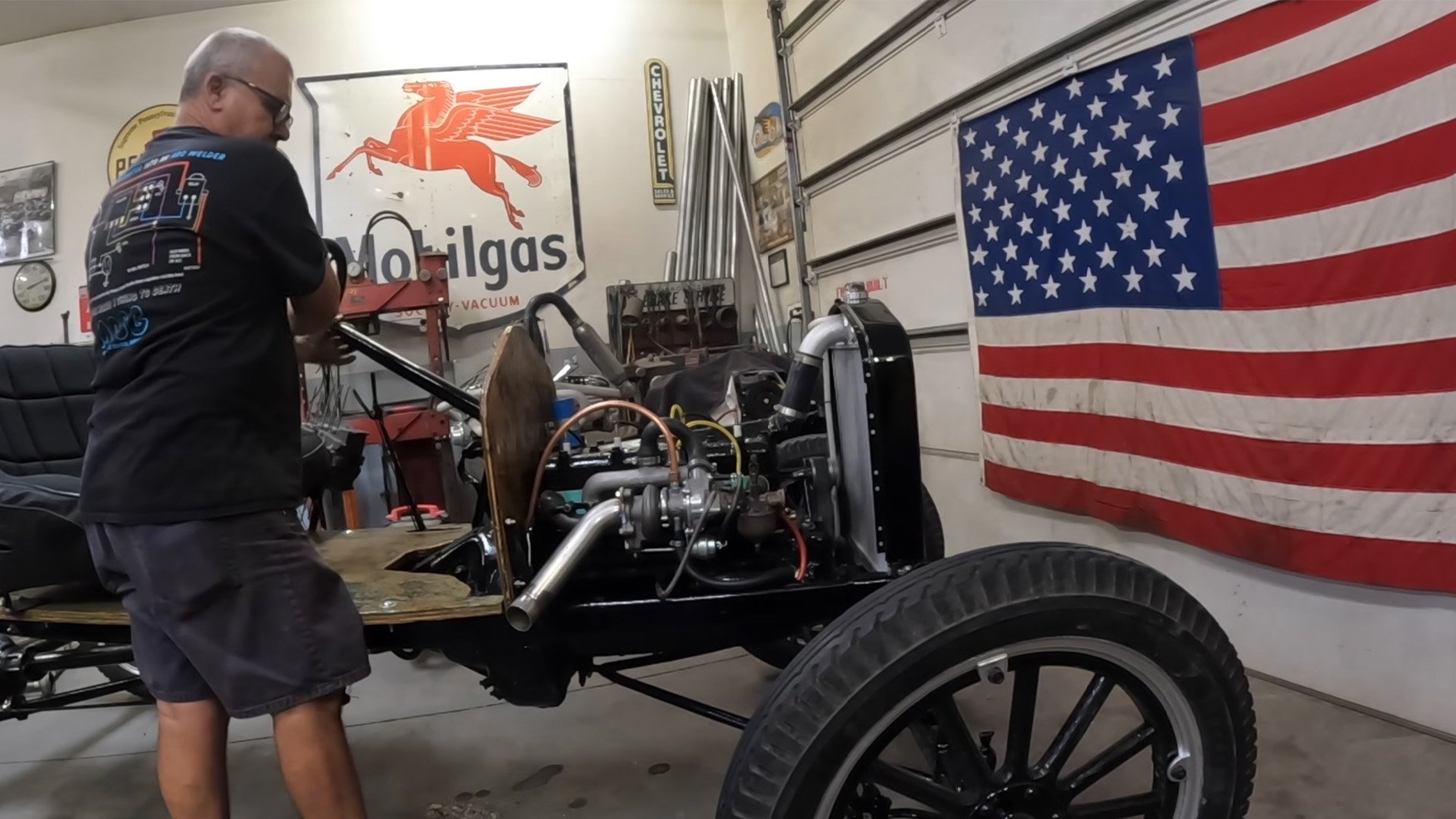
Which came first: The Ford Model T or the turbocharger? You might be surprised—just like I was when I googled it—to learn that the turbo is actually a bit older. Swiss engineer Alfred Buchi may have patented a design for exhaust-driven whirlers back in 1905, but such a newfangled contraption was the furthest thing from Henry Ford’s mind when he created the Model T in 1908. Now, more than 100 years later, those two influential innovations have been married together in some guy’s shop.
That guy is Merlin Johnson, and he’s an experienced hot-rodder, no doubt. He runs Merlin’s Old School Garage on YouTube. See, Johnson has a Ford Model T with an original 177-cubic-inch four-cylinder that made 20 horsepower when it was new. He also has a turbocharger off a compact Kubota tractor. You can probably guess the logic that led him to combine the two.
Physically installing the power-adder was simple. Johnson took the original cast iron exhaust manifold off the engine, cut a hole, fabricated a flange, and bolted the turbo onto that. But the tricky part was lubricating the boost device.

Model T engines don’t have oil pumps. Instead, there’s a tube that carries oil from the front of the engine all the way back to the transmission, as part of a “dipper slinger” design. For the turbo to work, Johnson had to find a way to tap into the system, lest it spool to its inevitable (and immediate) death. He solved this conundrum by using centrifugal force from the flywheel to push oil through a copper tube that then feeds the turbo. A simple siphon drain then returns the oil to the engine.
A quick startup in the shop was promising, with no oil leaking from the homemade solution, and the test drive proved that it works. Johnson’s initial stroll around the neighborhood showed some serious performance gains, with a 28 mph top speed—a five mph improvement over stock. He said it peaked around six pounds of boost, so it’s good to know that a stock Model T can hold at least that much without going kaput or kablam.

Will this Model T Ford Run with a Turbo Charger?
Don’t think you’ll see a bunch of other Model T owners boosting their sidevalve engines. This is by no means the cheapest or most efficient way to make them go fast. But it’s still interesting to see how the century-old engine responds to a little extra pep. The first factory-turbocharged car wouldn’t come along for almost four decades, as General Motors introduced the Oldsmobile Jetfire in 1962, and it’s not like the Model T was developed for high performance.
That never stopped people from modifying them before, and as you can see, it isn’t stopping hot-rodders today, either.
Got a tip or question for the author? Contact them directly: caleb@thedrive.com
Loading comments…
Comments couldn’t be loaded. Please refresh the page.