
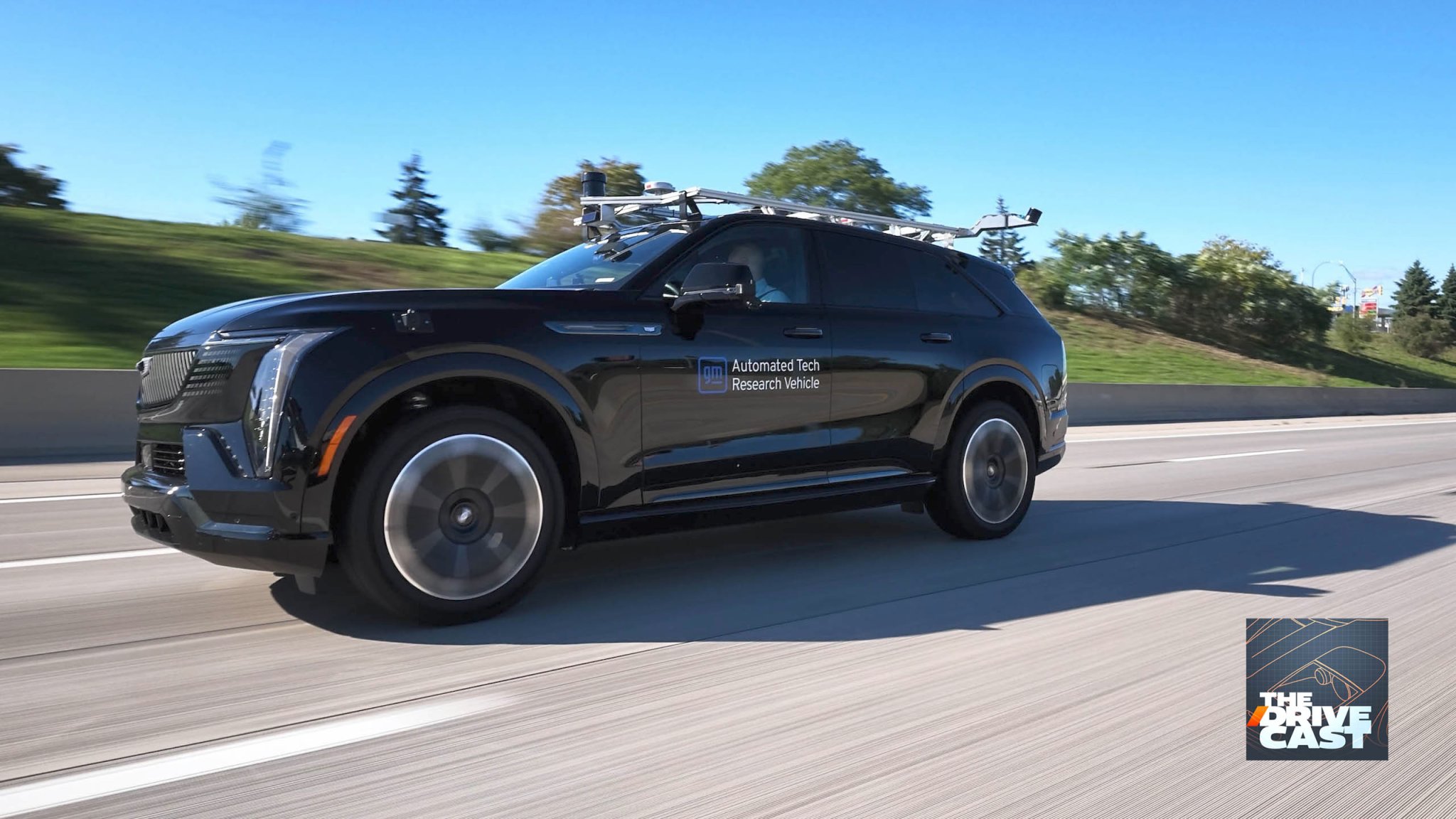
General Motors’ executive team just laid out the iconic automaker’s future road map while placing some big bets on technology.
On the latest episode of The Drivecast, Jaclyn McQuaid, who is the senior vice president of vehicle products at General Motors, sat down exclusively with The Drive for a candid discussion about the future of General Motors including a new centralized electrical architecture that will underpin its next-gen EVs and gas-powered vehicles, product development accelerated by the use of AI, a clean reboot of OnStar, next-gen batteries, and eyes-off autonomy.
General Motors is out to prove its decades of experience, which has given it troves of data, can be used to its advantage as it competes with smaller, newer players. The implementation of AI will, according to GM executives, cut vehicle development time in half while also streamlining manufacturing processes. But the use of AI will go far beyond moving internal teams from working in a series arrangement to a parallel setup.
General Motors is rebooting OnStar and morphing it into a personal AI assistant. That feature will extend beyond the car itself as GM kills off its individual brand smartphone apps and merges the owner experience into a new OnStar smartphone app in 2027. Then, in 2028 a new clean-sheet electrical architecture built around a central compute unit will arrive in the 2028 Cadillac Escalade IQ. With it will come a new hands-free eyes-off driving system that will first be limited to highways before expanding to more roads. The system will quickly expand to GM’s gas-powered light-duty trucks. Eventually, the goal is for your truck to run errands without you. All of this sets the stage for GM’s next-generation EVs, which will use LMR batteries that are said to be less expensive than today’s NMC batteries while being more energy dense than LFP batteries.
First time? The Drivecast is The Drive‘s weekly podcast that takes you behind-the-scenes on the largest controversies, stories, and characters shaping the automotive industry along with the way our roads look today. Powered by The Drive‘s inside access, original reporting, exclusives, and insights, The Drivecast aims to make everyone an insider.
Listen to The Drivecast via Spotify, Apple Podcasts, or Amazon Music. Love it? Like it? Want to help? Leave a five-star review on your platform of choice to help get The Drivecast
Full Transcript
Joel: Jaclyn, you lead and are responsible for GM’s overall portfolio of products. And at one point, you were the chief engineer of HD pickup trucks, before that you were in charge of seats, brake systems, exhaust, NVH, and handling. That’s a wild career. How did you get from testing seats and proving HD pickup trucks to now you’re basically leading the portfolio of GM products? Like walk me through that transition. That’s crazy.
Jaclyn: Yeah, so first 20 or so years of my career through various areas in engineering, you’re right, exhaust, tire, wheel, brakes, spent some time with seats. I actually spent some time with global purchasing and supply chain, learning that side of the business, and ultimately ended up as the chief engineer for heavy duty pickup truck. Actually, General Motors had never had a chief engineer of heavy duty pickup truck before that time. Heavy duty pickup truck had always been on the same architecture as light duty. It had a stiffer spring, it had a bigger prop, but it was effectively a beefed-up light duty. This was when we said, “No, we’re going to do a unique architecture for heavy duty truck, and we want a chief engineer to run heavy duty pickup.” And so I came over and I did that. Did that for about three years, and from there became an executive chief engineer. So I had midsize truck, medium duty truck, our beloved G-van, and then ultimately, our entire full-size truck portfolio including the full-size SUVs. So in total, about seven years being a chief and an executive chief across really all of our truck portfolio. From there, I went to Europe. I moved to General Motors Europe. I was president and managing director of General Motors Europe for a couple years, and it was really re-entry into the continent. We left in 2017. And so, really reimagining, blank sheet of paper, reimagining how would General Motors re-enter this continent. Did that for a couple years, was brought back to run Buick and GMC. So I ran sales, service, and marketing for Buick and GMC, two brands that I dearly love. And then got a call asking if I’d be willing to come back to my roots in product and run all of the vehicle products. And that was, has been for the last six months, really interesting. I’m a truck girl at heart, and so learning performance car, getting my fingers a little bit as much as Tony will let me into Corvette and Blackwing and some of the areas that I haven’t experienced before, it’s been really fun.
Joel: So, it’s funny you mention Tony, obviously, you know he was just on the podcast. We’re a fan. Obviously, we’re a fan of the Blackwing. Blackwing was our car of the year last year, was our sports car of the year. We’re big Blackwing fans. But I also am curious, so does that mean, would you say the HD trucks are kind of like your baby? Like are you a truck girl? Is that your passion?
Jaclyn: Very much so. Learned how to drive on an ’82 Suburban. Body-and-frame trucks has been my passion. It was interesting, I became the chief engineer of heavy duty trucks, and I was 39, 40, and it’s kind of like, crap, now what do I do? I’ve kind of reached my pinnacle. I better find a new pinnacle. And so started to really look at what’s next, wanted to stay with trucks as much as possible, and that’s why I became the executive chief engineer of the entire truck architecture. But even today, it’s been years since I launched the heavy duty truck, what we called T1, and I still see someone driving on the road today in one, and I just get a real big sense of pride. I see happy customer behind the wheel. It’s my baby.
Joel: Okay, and before we get into everything, all the news and everything, I got to ask, cause you mentioned the van.
Jaclyn: Yeah.
Joel: Will we ever get a new van?
Jaclyn: We’re going to start early?
Joel: That was not on the original questions, but you mentioned the van. It’s like, I know we just swapped out the head units…
Jaclyn: I love the van, and I will tell you this, I tell people all the time, you haven’t worked at GM until you’ve worked on van. It’s the Energizer Bunny. It just keeps going. I don’t know, stay tuned, Joel.
Joel: That was not even part of the questions, but you mentioned the van. So, all right, before we get into the news and everything that Mary and Reuss just announced today, you guys are currently launching new V8s. You’re overhauling full-size gas truck lineup including light duties and heavy duties, your babies.
Jaclyn: Yep.
Joel: But Mary and Mark have both repeatedly, undoubtedly said that the end game is EVs, the future is electric. You guys as a company have put that stake in the ground. How do these two things, the V8s and we have the new trucks, align with the future is electric? Like that juxtaposition.
Jaclyn: Yeah, it’s really all part of the same. I mean, it’s a journey. It’s not a binary switch. You don’t go from gas diesel powered portfolio to an EV portfolio and expect the entire consumer base to switch. We have to take them on a journey with us, and part of that journey is more efficiency in the ICE and diesel space. When you look at the Gen 6 V8s that we’re releasing actually as we speak right now in the light duty, look at the new powertrains we’ve got in the heavy duty, the Mongoose that we’re really proud of…
Joel: Cool name, by the way. Cool name.
Jaclyn: Thank you very much.
Joel: I like the name. I like the marketing. The launch video was cool. I was, look, everyone loves a rivalry. Everyone loves a crosstown rivalry, and that is, it’s a fun one.
Jaclyn: And we have the numbers to back up the video. We have the horsepower, we have the torque, we have the towing, we have the numbers to back it up. But those in addition to giving you higher performance from an output perspective, they give you higher performance from an efficiency perspective. So they’re part of our journey towards ultimately a zero emissions future.
Joel: On that, a big thing that was laid out in the announcements that Mary and Sterling and Reuss have gone through is the use of AI, virtualization to cut vehicle development times in half. And if I remember correctly, and correct me if I’m wrong, I’m sure you will, vehicle development times today stand at GM around four to five years, right? Which means that using AI and virtualization and all that stuff, it could cut vehicle development times to two to two and a half years, is that correct?
Jaclyn: Yeah, you’re right. We’re looking at cutting it at about in half with AI and virtualization.
Joel: So, if you’re cutting a vehicle development time to let’s just call it two to two and a half years, what does that translate to in terms of the effects that consumer and the company see in terms of products?
Jaclyn: I mean, from a consumer perspective, look, we’re doing the development closer to when the consumer is actually going to have the vehicle, right? And that goes a long way. We’re really understanding what the consumer is looking for, where the industry is going. We want to get in front of the industry. We want to be a leader in technology and innovation. And so developing the vehicle closer to time to market is a huge advantage for the consumer and a huge advantage for us. It also is a huge advantage because it gives our employees the opportunity to do what they do best. The reason the development time was four to five years is because it took a whole lot of time to do something. So designers would come up with a theme and it might take weeks to mold it up in clay, get it into a wind tunnel, do the testing, understand what the aero is of it, bring it back, make some changes. You go to CFD analysis, that sped it up a lot. You’re going from weeks to days, but you’re still days. Where we’re going with AI and virtualization, you’re talking minutes. It allows the designer sitting with the engineer to iterate constantly and continue to find that great theme that enables what the engineer needs from an aero perspective and what the designer wants from a theme perspective. It allows them to do what they do best, and it allows them to do it quicker.
Joel: So does that mean, like before, the departments must have been separated a little because you had the designer, you’d have the aero guy, and then you’d have the guy that has to actually at one point sculpt with clay, then we were doing CFD, like you said, with some computerization. But you mentioned that these guys can now sit next to each other, and they can run the models and make changes in real time. So is this actually enabling you guys to collaborate more as a team?
Jaclyn: Yeah, very much so. It used to be really a series process, right? One individual would do their job, the designer knew what aero target they needed to hit, they would iterate, they would iterate, they would iterate, and then they would hand it off. Now everything is being done in parallel. So the designer is sitting with the engineer, and in fact, oftentimes sitting with the manufacturing engineer as well because, frankly, the parts need to get out of the tool, right? You need to be thinking about how you’re going to manufacture the design that you’re ideating in, creating. And now we’re doing that all together. The teams are sitting together. In fact, with some of our programs, our fourth-generation EV architecture program as an example, they’re sitting in a separate building all together. Different functions that are working on this program are all sitting together in the same building.
Joel: You’re getting ahead of me. I want to talk about that. I’m sorry. I want to talk about the fourth-gen product, but before we go into that, I want to go more on the virtualization. So, when you’re shaving off time, theoretically, I’m assuming that shaves off cost, right?
Jaclyn: There are a lot of things we’re doing to shave off cost. Yes, it does. It shaves off cost from an engineering resource perspective. The number of hours that need to be spent developing that vehicle contract significantly.
Joel: So if you do that, does it also contract and shave down on production efficiency and make it more efficient to actually build these things and get them into production?
Jaclyn: There’s a lot that we’re doing for that, too, but one of the things is this parallel activity. When you’re designing, considering manufacturing as you’re making the design, it used to be manufacturing was the afterthought. You’d get the engineering done, and then we’d hand it to manufacturing, and they would have to figure out how to build it. That’s not efficient. When you’re doing it all at the same time and you’re thinking about that when you’re engineering and designing the vehicle, it becomes much more efficient from a manufacturing process. And then we’ve got AI for manufacturing as well. So we’re using AI tools, we’re using virtualization to actually set up our lines. We’re using twins to really understand what the line is going to do. So we can lay out the manufacturing line before we build a single vehicle down it and make changes to it. So we’re using the technology in the manufacturing space as much as we’re using it in the design and the engineering space.
Joel: So just to be clear, cause this is kind of cool, you guys are making a digital twin of the manufacturing line and then you’re, I mean, are you basically running a digital production line and you build a car digitally and you can find the faults all using AI and digitalization?
Jaclyn: We run ergonomic analysis, we run routing of hoses, we run line-side, how much room are we going to need for line-side, we do it all virtually before we actually build production.
Joel: That’s really cool. So if you guys are being able to save the cost on the front end of the designing and engineering and the aero and all that stuff, and then you’re able to save it on the tooling, the line stuff, and all that stuff, I mean, the average transaction price of a car today, you got you’re well aware of, is about $50,000. Trucks are about $66,000 give or take. Obviously, eggs and milk don’t cost what they used to either, but do you see the cost savings can enable cars to cost less and bring the cars’ cost down, or you don’t see it in that way?
Jaclyn: Affordability is something we talk about all the time, but to be clear, when you look at the General Motors portfolio, we actually offer a lot of vehicles at or under $30,000. In fact, this year alone, we’re going to be selling 700,000 vehicles at $30,000 or below. We have an actually pretty broad portfolio of highly affordable vehicles that are still fantastic Chevrolets, fantastic Buicks, fantastic GMCs. And so we are focused on affordability now, we’ll continue to be focused in the future.
Joel: All right, so moving on to next-gen BEVs, and I definitely want to talk about this. You guys have talked about the next-gen drive units, they’re reducing parts count by 40%, they’re cutting mass, they’re freeing up space. Obviously, Rivian, Tesla, Lucid, they make their new motors in-house or have been, depending on which automaker we just listed. Other models to date, the Ford Mustang Mach-E, those motors are off the shelf, a lot of the Ultium motors are off the shelf, you guys didn’t you aren’t building your motors today. These new motors, are these off-the-shelf motors from a supplier, or are you building your own motors now?
Jaclyn: These are motors that we’re designing, developing, certainly we’ve got some expertise in some supply bases that we utilize, but we are building these motors. These will be our motors for our electric vehicles.
Joel: Okay. So moving into batteries, cause batteries, obviously, there’s a lot of components to an EV. I know there’s not as many as a gas car, but batteries are a big deal. A lot of vehicles today use NMC batteries, some people have used LFP batteries. LFP batteries, they save cost, which we’ve just talked about cost, but when you’re pulling the cost out, but they’re less energy dense, they don’t have as good of cold weather performance, so there’s some real downsides to it. You guys are moving to LMR batteries. Talk to me a little bit about the benefits of an LMR battery as we move off LFP and NMC.
Jaclyn: So we have a whole team led by Kurt Kelty, who is our battery expert at GM, who really dives into battery cell chemistry and what the right solution set is for what we’re ultimately trying to deliver. And we do believe LMR is the right strategy, particularly for this fourth-generation EV architecture, but potentially beyond that as well. The benefit of LMR is it gives us very close to the cost of LFP, but very close to the range of the high nickel. So it’s got higher energy density than the LFP has, but it doesn’t approach the cost that a high-nickel battery would generate. And so we really are getting the best of both worlds.
Joel: Have you guys looked into, and I know Mercedes, they haven’t really put this in a production yet, but I was with them, and they were talking about mixing and matching cell chemistry for different various use cases, so you’d maybe have an NMC or a LMR or any of these different batteries, but then you’d have solid state, and the solid state would be really small, but it’d be like for track use, and you’d be able to automatically switch. Have you guys looked into that, or is it not a use case for you guys?
Jaclyn: For the fourth-generation EV, it’s not something we’re applying, but it is something that we’re looking at.
Joel: So the actual platform itself and the batteries themselves, obviously removing battery packs and the chemistry, will the platform be built around the battery or will it be more like today’s? So what I mean that is like Tesla or say Volvo in the EX60, it’s cell-to-body technology where the batteries are integrated into the structure, it’s not a separate pack that’s dropping in and out, whereas Rivians are still using the drop in and out method. Do you know how it’s going to be packaged in the new BEVs?
Jaclyn: So it’s a cell-to-pack configuration that we’re using, and then dropping the pack.
Joel: So today’s BEVs, particularly the body-on-frames, they’ve a really big tank, right? And I mean tank, tank I mean battery, right? So they really go far. They’ve got really impressive range, cold weather range, towing range, unloaded range. But they’re not efficient. They have a really big tank. Will we see that change in terms of efficiency for the next-gen? Is that a focus?
Jaclyn: Absolutely, it’s a huge focus for us. I mean, we should expect to and we do see that efficiency with each next generation. We’re learning with each generation and driving more efficiency into the future one. So, I will say though, the EV trucks that we have on the market today, the range is incredibly impressive.
Joel: The range is incredible.
Jaclyn: It’s an incredible. I spent a year driving Silverado EV. Sincerely, you can.
Joel: You could do legitimately 400 miles.
Jaclyn: 100%. I mean, I’ve done it.
Joel: You’re getting 2 miles per kilowatt hour, but you can still do 400 miles doing 80 miles an hour. Now, where, of course, 80 miles an hour is legal, you’d be doing that.
Jaclyn: The goal would be to be able to maintain that range, but do it in a more efficient way so that you require less cells, less battery.
Joel: Smaller battery, similar range. Which makes it lighter and more efficient.
Jaclyn: And then there’s additional, and then more cost effective. I mean, the advantages continue to flow.
Joel: So, vehicle dynamics performance integration engineer Alexander Doss and I were together at the Cadillac Lyriq-V launch last year. And great guy, he was a lot of fun.
Jaclyn: Yeah.
Joel: I asked him at the time, because we were launching what felt like the pinnacle of the Lyriq-V Lyriq lineup at the time…
Jaclyn: Okay.
Joel: We were starting to talk about the next-gen EVs at the time, and I said, “What are the two things as a lead engineer on this stuff that you want as a target to hit?” And his two words were packaging and mass, those are the two things, which we’ve obviously talked about both those things. Talk to me a little bit about the packaging and mass in terms of today’s Ultium products, they have for all intents and purposes two platforms. You’ve got the ones that are on the trucks, so like the Sierra, Silverado, Hummer, and then you’ve got the ones that are non-the-trucks, and they share with everything from a Vistiq, which is large, to an Equinox EV, which is by comparison small. But because of that, Alex and I were talking about there’s commonized components. And the reason most of those vehicles have a really long dashboard that you’re sitting behind is because the HVAC controls are all under the dashboard, doesn’t matter whether it’s an Equinox or a Vistiq, they’re all there, right? It makes it easier to build, engineer, and design. But the turn of that is, you got this great dash-to-axle ratio and really long hood on a Vistiq. And you open it up, and there’s no frunk, even though it’s a huge area. Are the things in the next-gen platform going to be commonized like that again, or is it going to be more specific so that we have packaging where if you have a long hood, you have a big open space? Does that make sense?
Jaclyn: Does make sense. I’m not sure that I totally agree with Alex’s assessment of why we don’t have the frunk, for example, or what the packaging is. It’s certainly an interesting perspective, but I would say that there are advantages to commonizing, and you can commonize and get a really great packaging for a wide variety of vehicles, and that’s effectively what we were doing in our current generation architecture. And then we make decisions about whether or not we do a frunk and some things like that. But I would say that the commonizing that we do, it drives efficiency, it drives less resource spend, it drives higher quality because you’re not engineering an HVAC system as an example for each individual vehicle, you engineer it once, and you validate it, and you use it across multiple vehicles across multiple segments. I think there’s a whole lot of advantages to commonizing and using shared components, but I agree with him that there are opportunities from a mass perspective. And then as we continue to learn and get more efficient, there are opportunities to use the packaging that we have more effectively. And I think as we look at the next-generation EV architecture, we’re looking at doing exactly that while still leaning into the scale that we have and leaning into where we can be common.
Joel: I have no problem with the HVAC controls in an Equinox versus Silverado EV being the same, under the dashboard, it doesn’t matter to the consumer, totally doesn’t matter. And I would agree with that. I think Alex’s point was when I’m looking at a long hood and I’m like, “Why is there no frunk?” And he’s like, “Well, an Equinox EV doesn’t have a large hood, and so I’ve got to put the components in the same place, and so I’m limited by sharing all these platforms.” Obviously, these things were designed half a decade ago versus where we are today, so things were different, but let’s move on to OnStar. So OnStar is celebrating its 30th anniversary, which makes me feel kind of old, I’m just going to say it, but you guys are basically rallying around OnStar, and you’re basically turning that into a resurgence of a modern brand, you’re modernizing it, right? Because that is going to be the branding for in-vehicle AI system for you guys now.
Jaclyn: That’s right.
Joel: And I’m curious, millennials, boomers, everyone 35 and older, they know what OnStar is. We all grew up with it, there’s the blue button, you hit it, they can locate your vehicle, I remember the commercial where they could stop a robber because they can turn the car off remotely, there was the whole privacy issue back then, which is crazy to think about now in an era of Flock. But what about Gen Xers and younger people? Do they know what OnStar is or are we just creating a new OnStar for a new era?
Jaclyn: I think some of them do know what OnStar is, but the calling into an advisor might not be something that they automatically associate with OnStar because it might not be something that they have personally experienced. That having been said, they absolutely know what AI is. And so an opportunity to leverage what is a you know, a 30-year brand for us, and we have we’re approaching 13 million OnStar subscribers. It is a huge brand, current subscribers. It’s a huge brand within a brand for General Motors. And so I think that leveraging that, but bringing it to today, I mean, I have an 18 and a 20-year-old, so they’re driving vehicles today, and bringing to them the power of OnStar without losing the power of OnStar that our older customers that have been using OnStar for quite some time really value. Even with OnStar AI, you can still connect to a live advisor.
Joel: I was just going to ask you, if I hit OnStar in a car, do I still connect to a live advisor inside General Motors?
Jaclyn: If you say, “Hey OnStar,” and you have questions that you want to ask, and at some point, you’re diving into a question about maybe a DTC that has been set and you want additional information, you can ask it to connect you to an advisor, and a live advisor will be there for you.
Joel: I still remember the first time I went into the actual OnStar call center. I was early in my career, and there was this huge screen, there’s all these dots on it, there are people with headsets on, just like as if you walked into like a 911 call center. It was crazy. It was really cool. Then I think they had like the hurricane response team set up for like the Southeast, it was really interesting.
Jaclyn: It is really interesting, and it’s a way to take what customers love today and grow it, but don’t get rid of what customers love today. They still love that.
Joel: So I have to ask, obviously, for those that haven’t seen the announcement, OnStar is everything’s being consolidated under there. So if you have you’re going to have OnStar AI agent, it’ll be your OnStar assistant in your Cadillac, your Chevy, your GMC, and your Buick, right? So I’m curious, why going OnStar in all the brands versus you could have a Chevy assistant, you’re going to have a Cadillac assistant, you’re going why not the brand uh keeping the brand inside that vehicle versus OnStar across all of them?
Jaclyn: OnStar’s a really powerful brand in and of itself, and it connects what we’re doing across Chevy, Buick, Cadillac, GMC. It also connects what we’re doing across our fleet space. It’s a brand that can pull an entire family together. If you have a family fleet of cars and you’re driving a Chevrolet, and your wife’s driving a Cadillac, and your son’s in a GMC, it’s an app, it’s a brand that can pull that entire family fleet together under one name.
Joel: It’s funny, I want to go come back to that in a second because I have a question about that, but before we go to that, I want to talk about the like realities of it in the bones of it. Which LLM, you guys didn’t create an AI agent, you know, Siri’s now using Google’s LLM, right? Which LLM are you guys teamed up with for the backbone?
Jaclyn: Well, we started with Gemini because we have a partnership with Google with Gemini, we started with that, but then we went deeper, and we built it into our product. And what’s really interesting and advantageous about OnStar AI is it can do more contextually with the vehicle than an AI agent that sits sort of on the surface of the software, right? Because when it’s built by GM engineers to go into the vehicle and really understand it, if you were to ask what’s happening with a DTC, you know, with an agent that sits on top, you can say, “I’ve got a DTC that looks like an exclamation mark, what does that mean?” And it can tell you what industry standard that would mean, but with OnStar AI, it can actually tell you exactly what code has set, if why it’s been set, when it was set, it can offer to schedule you a service visit if you need to get into a dealer, so it’s contextual exactly to the vehicle that you’re driving.
Joel: And for people that don’t know what DTC is, because you’re used to building trucks…
Jaclyn: Diagnostic trouble code. Yes, yes, it is a diagnostic trouble code. So if your dash sets a light for some reason, that was what we would call it.
Joel: Pretty sure my mom listens to this sometimes, and she would definitely not know what that is.
Jaclyn: Okay, sorry about that.
Joel: It’s all good. So, now going back to what you talked about with, you know, the family of OnStar, dad’s got a Cadillac, and the kid’s got a Chevy, and the mom has a Buick or whatever…
Jaclyn: I think I said mom had a Cadillac. I think that’s super important.
Joel: The mom has the Cadillac, the dad’s got the GMC, and the kid’s got the Chevy. There you go. Talk about OnStar vehicle app consolidation. So like right now, you have a Chevy app, you’ve got a GMC app, a Cadillac app, and a Buick app for your Android phone or your Apple phone or whatever, but all those things are being consolidated into an OnStar app.
Jaclyn: That’s right.
Joel: ..And so that kind of makes it so to your scenario where mom has a Cadillac, and dad’s got a GMC, and kid’s got a Chevy, and grandma’s got a Buick…
Jaclyn: Yeah.
Joel: …I don’t know, hip grandma. All those are in one OnStar app, and does that make, because right now, you would need an app for each one of those brands.
Jaclyn: That’s right.
Joel: So the dad would need four apps or three apps. Right now, if the dad has coming forward, to my understanding is, that if the dad has the OnStar app, he can pull up his OnStar app, and he can see all those four vehicles, even though they’re different brands within GM, is that accurate?
Jaclyn: Yeah, now what a lot of people don’t know actually is within my GMC app, for example, you can load your Chevrolet or you can load your Cadillac. Yes, you can. I’ve done it personally because we have multiple GM vehicles within the household, but it’s not intuitive. Why would someone think that, right? And so…
Joel: I didn’t know that.
Jaclyn: Right, and so you would have a myGMC app, a myChevrolet app, a myCadillac app.
Joel: That’s clunky.
Jaclyn: And it’s clunky. It is clunky. And so putting it all together in one space, integrating it, it just makes a whole lot of sense. And then, you know, what you’re doing with OnStar AI in vehicle flows through to your mobile, it flows through to fleet accounts, everything is together under the OnStar branding, which, as I said before, is a really valuable branding for us.
Joel: What do you mean by it flows into the mobile app experience with the AI agent?
Jaclyn: This year, we’re launching OnStar AI in our 2027 Lyriq. Next year, it will expand into other products, and as it expands to other products, additional use cases and additional applications of OnStar AI will flow through to the point that we’ll be able to do things within the mobile app and send it right to the vehicle.
Joel: Got it, okay. So, and I was going to actually ask you, because I did note that they mentioned that on stage that the model year ’27 Lyriq would be the first one to get it via an over-the-air update in the coming months for free, I assume. Will that be able to go to previous model years, ICE vehicles, or is it only when it rolls out going to be future? Does that make sense? Like, can a ’26 and I’m not going to hold you to the actual cars, but we have a lot of BEVs, Hummers, and Silverado EVs and Lyriqs that aren’t ’27s, they’re ’25s and ’26s. Is it backwards compatible or only forward compatible?
Jaclyn: So we’re not announcing any back-casting plans right now, we’ll let you know.
Joel: Okay. So, moving on to software-defined vehicles, which is a huge deal in the industry, whether it’s the Chinese, Rivian, or you guys. Over-the-air updates are a huge deal because when there’s a recall, it’s really not convenient in this era, I mean, I’m busy, you’re busy, you’ve got kids, you get it, even people that don’t have kids are busy. Going to a dealership is not convenient to get my headlight software flashed. It’s just not. And so the ability to download it on Wi-Fi while you’re at home and you’re going to bed is convenient. Let’s talk about the actual software vehicle situation. You guys have a new electrical architecture coming, it’s new with a new compute system. Is this true over-the-air updates, like we don’t need to go to dealerships if it’s not a hardware physical situation going into the future?
Jaclyn: Yeah, so the Cadillac Escalade will be getting software-defined vehicle architecture first, and that’s coming in 2028. Escalade
Joel: IQ,
Jaclyn: Yes, Escalade IQ, yeah. And that’s in 2028, and with it will come significantly enhanced over-the-air upgrades and opportunity. I can’t sit here and say that everything will be OTA-able, there may still be some, but the goal is twofold, the goal is to significantly reduce what would need a dealership visit versus what can be done OTA, but candidly, when you’re doing a central compute and when you’re doing a central compute that can flow across the entire portfolio, whether it’s gas or whether it’s electric, and so you have common software, and this gets back to the value of commonization where brand specificity isn’t necessary, when you can be common across this software that’s in a central compute, it should significantly reduce the amount of times that you would have to go to a dealership anyway because you’re engineering it one time and you’re validating it one time, and you’re using it more broad-based.
Joel: So a lot of cars, to be clear, this is not talking about you guys, just like there are electric cars out there that are from competitors of yours that are not Rivian, Tesla, and Lucid, which feel like they’re non-legacy automakers, right? There are other legacy automakers that right now if you need a software update, you need to do an over-the-air update, I’m using air quotes that people can’t see because they’re not with us right now, you would need to download it from your computer onto a USB flash drive, then you put the USB flash drive into the car, and then you sit there, and we’re going to disable your car, it’s crazy, that’s not an over-the-air update, by the way. I’m curious, to be clear, yours are going to be downloaded from the cloud, goes Wi-Fi, delivers to the car, car’s just like a Rivian, unusable while or Tesla, unusable while it’s in 15 minutes installing or whatever, you do it at night, schedule it or whatever, and then it’s done.
Jaclyn: Yeah, and just to be clear, this wouldn’t be brand new for GM. We have that today. I’m in a gas-powered truck today, I’m in one of our brand new light duties, and I got an over-the-air update just a couple days ago, 15 minutes, I said, “Yep, go ahead and accept,” and got in and the software had been updated.
Joel: But this is going to go much farther than today’s capabilities.
Jaclyn: Absolutely, because today we’ve got dozens of different modules, and some of them are OTA-able, some of them might not be, when you go to a central compute, you significantly expand what is capable of an OTA.
Joel: So glad you brought that up, because the next thing I really want to talk about is the central compute. So I know one of the big deals is talking about one central compute unit, one CCU. To be clear, CCUs, is that one ECU, or is a central compute unit different? I want to be clear on the language.
Jaclyn: We call it a central compute, it really takes pretty much dozens of modules and puts it into one, so, yes, it’s got engine…
Joel: It’s one unit.
Jaclyn: It’s one unit.
Joel: Okay. So, because it was interesting, cause originally, I think the Lightning, I only know certain other cars, Lightning had like 80 or 90 ECUs at one point, and the Rivian launched, and they had 17, which everyone in the industry was like, “Woah, right, that’s 17.” Then all of a sudden Rivian came a couple years later, and they had seven, which is like, that’s intense. So you guys have…
Jaclyn: So Rivian is zonal.
Joel: Yep, zonal. Northwest, east, it’s a map architecture.
Jaclyn: And zonal’s got…
Joel: Pros and cons.
Jaclyn: But there is still the opportunity for fragmentation and latency when you’ve got zonal compute as opposed to a single central compute. Pros and cons with a central compute as well, it’s quite large, and so you have to package it, but you eliminate some things like latency and fragmentation when you’re central.
Joel: But so central compute that you guys showed today in the Escalade IQ, for that model, be about in the dashboard behind the glove box, but it might change based on packaging a vehicle, Escalade’s a lot bigger platform than Equinox EV.
Jaclyn: Escalade has more options of where to put it because it’s got more room, got more room, right? And so, yes, as you look at different products and depending on packaging space, it might have to move slightly.
Joel: So can we talk a little, I mean, I’m well-versed in zonal architecture that you mentioned the terms zonal architecture for Rivian, I’m well-versed in that, and there are pros and cons to that, as you mentioned. Obviously, there’s a lot more cons to something like a let’s just say a Lightning, cause that’s the example I used earlier, where they have 80 ECUs, cause when you have 80 ECUs or plus, they might not all be from the same supplier, just for people that are listening and don’t know this, and so if you got a supplier from, if you got ECU from Bosch, you have one from Continental, and you’re like, “I want to change the way something operates,” you need these two ECUs to communicate, two different suppliers, you need to figure out how to then over-the-air update a software that’s going to make these talk. Can you explain the benefits to a central compute non-zonal, non-7, non-80 setup?
Jaclyn: Well, I mean, part of it is that we’re bringing the software in-house when we do this. And so we’ve got our engineering team, our software engineering team writing all of the code and making sure that everything is speaking to each other, it is available for OTA. It’s quite a large undertaking, but it allows us to move with faster speed, the connectivity is going to be faster, the headroom for growth of features is going to be significantly greater than what we have today, we’re going to want the vehicle to be able to grow with the consumer in a way that right now today we can tap out pretty quickly to that headroom, and so those are some of the advantages that central compute’s given us.
Joel: All right, so on the future growth headroom topic, this is actually something I’ve talked to Rivian and Tesla and all of them about. Rivian originally said that their goal is, just like yours, future headroom. And they’re viewing it kind of like an iPhone, you buy a computer, you know, back in the day, your computer only last a couple years, now the headroom on a computer, it’s much longer, they’re more powerful than ever. Rivian told me that their goal is that software will enable the vehicle to grow with you over the course of about 8 to 10 years, and then you’ll still get security updates, just like you would like your iPhone or your computer, but you’re not going to probably get feature updates, which the idea of a brand new gas-powered vehicle six years ago getting feature updates today still is that’s an abstract concept, we never would have thought of. How much headroom are you guys building into them in terms of we feel you can get feature software updates, not security updates, into the future of X, your car will continue to evolve with you for X years versus today?
Jaclyn: Well, so what I would tell you is the new electrical architecture will give you about 40 times more compute power than what we have today. So that’s fairly significant in terms of the feature growth. It’s so hard to say, Joel, because I don’t think any of us can sit here today and say what features we can even imagine in 5 years, in 8 years, in 10 years. And so for me to put a limit on it just doesn’t feel like what we would want to do. What we’re doing today is creating a system that’s got so much more compute than what we have today that we can continue to be creative, continue to innovate, continue to find those features, and let the vehicle grow with the consumer.
Joel: That’s fair, 40 times is a lot. Let’s talk about autonomy and hands-free, which is a huge topic, obviously. Super Cruise is one of the single greatest hands-free systems on the market, like by far.
Jaclyn: You love it.
Joel: I love it, I’m a huge advocate. I would say that until you, unless you take a system that is fundamentally different, like Rivian’s and Tesla’s doesn’t use mapping data, that’s a fundamentally different system, but of the systems that work off map data, you guys have the most detailed map data because it’s using LiDAR, not radar data. You guys have an HD GPS receiver, which other people are using regular GPS receivers, so people that don’t know, a regular GPS receiver places a car on a road because it has a span of about 40-some feet, whereas an HD GPS receiver, which costs more money, has a span of 6.6 feet, it knows which lane the car is in. You guys also use dead reckoning, I did the launch of Super Cruise, I’m a huge fan.
Jaclyn: Which is why when you look at the expansion and development of our native system or native UI system, combined with Super Cruise, right, it can follow your Super Cruise line, it can change lanes…
Joel: So that was my question, so right now Super Cruise works on some 750,000, I’m rounding, miles of road of map data, which is by far the most of anyone, again, that’s not a Rivian or Tesla doesn’t need a map data today. But Super Cruise is a hands-off, eyes-on, so you’re watching the road, but you’re not having actual like control of steering wheel, the throttle, the brake pedal system. The next system that’s coming for you guys, and you’ve already announced this, is the hands-off, eyes-off that’s coming to Escalade. That’s a little more similar to something that but even Rivian and Tesla, you need to have your eyes on the road, you’re supposed to be paying attention. The Escalade IQ is getting that first. Will we see this be democratized across the lineup in terms of like, we have everything in Super Cruise and Equinox EV today, how democratized does GM want to make a hands-off, eyes-off system?
Jaclyn: So our highway autonomy system that is launching on the Escalade IQ is something that we’re looking to flow into the product portfolio. We’re going to start next with our full-size pickup trucks, and so that will be the next product that we’re going to take it to, and then we’ll see, we’re going to continue, but our goal would be to put it on the highest volume products, get it to the largest customer base we can as quickly as we can.
Joel: Does it have a place in HD pickup trucks? I only go there because I know they’re your baby.
Jaclyn: Wait and see, can’t wait to share that with you.
Joel: Okay. So, will this have a point-to-point portion feature, or is it just a hands-off, eyes-off?
Jaclyn: So right now it’s highway autonomy, that’s what we’re announcing for the Escalade IQ in 2028. Obviously, we’ve got a great team of engineers that are continuing to work on what comes next.
Joel: Will the autonomy hands-off, eyes-off require map data still be used, or can you use it on unmapped roads?
Jaclyn: We’re using it on mapped roads.
Joel: Mapped roads only, okay. Still the LiDAR mapping, the stuff we have today. Okay, good. Do you see a future where a GM vehicle doesn’t need a steering wheel anymore?
Jaclyn: That could absolutely be some point in our future, I don’t know when.
Joel: Not in immediate future.
Jaclyn: Oh, I, but I envision a day when we can. I mean, I still remember the day I had to take the car keys away from my grandma, and she lost her independence. I would love a day when we get to that level of autonomy where we don’t have to take that level of independence away from the people that we love, and the vehicle can be trusted to do for them exactly what it needs to do for them. So I definitely think it’s in our future, it’s something we’re working really hard towards.
Joel: Well, it’s interesting because Alex Roy, I don’t know if you know him, I know some of your team members know him, he did the world’s first New York to LA full self-driving autonomous where he didn’t touch the steering wheel and it did it, and we were talk we had him on the podcast, and we were talking about it, and he was just like, “This unlocks, once this is replicable in every condition with every person, it’s not Alex Roy, and not a the professional autonomy expert, it unlocks so much potential for those with disabilities and handicaps or that age out of driving, any of these things, to get to places,” that he was just like, “This is almost a safety function, like this, when we can do this and replicate it through any weather, in anyone doing it, this is a safety function.” Now obviously, enthusiasts that love Blackwings are like, “What do you mean you’re going to take my steering wheel or my third pedal? You can pry it on my cold…”
Jaclyn: But it doesn’t have to be a one-size-fits-all answer. I think some people get concerned about that because there’s this, you know, idea that it’s one-size-fits-all and it’s going to necessitate that we flow it through the entire portfolio. There are still use cases I see, I mean, look at how invested we are in racing, and invested we are in F1, and invested as we are in NASCAR, etc. So, this concept of personal autonomy, I mean, we can talk about what others are doing in the robotaxi space, it’s better up, but this concept of personal autonomy, I understand your friend saying it’s a safety feature, I can agree with that to an extent, but I also think it’s just the advancement of societal needs and the role that General Motors can play in society, and giving people back what they had as they advanced through the years and what they were at risk of losing. I am personally incredibly proud of the work GM is doing towards personal autonomy, and I think it’s going to have a role to play for, you know, me one day as I get to that point in my life, and many of us, but we’re giving people back their livelihood with personal autonomy.
Joel: So I’m curious on that, talk to me a little bit about when you say personal autonomy, obviously, you’re viewing that very differently than the robotaxi space. What is the difference between like the definition or difference between robotaxis, which arguably are self-driving cars, I guess, and the personal autonomy space?
Jaclyn: In a lot of the cases, robotaxis are confined to certain cities, and you’ve got, you know, 20-some cities around the country, and there’s robotaxis that have been very clearly, you know, assigned there and they know those cities and they can navigate them, but what I’m talking about is somebody getting in their car in New York and saying, “I want to go visit my daughter who lives in LA. Let’s go.” And they own the vehicle, it is their personal autonomous vehicle, can take them where they need to go, it can take them to pick up their dry cleaning, it can take them to, you know, pick the dog up from daycare, it can take them wherever they want to go, and it can take them across the country to go see their daughter.
Joel: So in that vision, cause this is obviously an enthusiast concern, right, of self-driving cars, you view a world where you still because you mentioned something key in there, you still own the car, it’s your car. So you’re not viewing as a world where driverless cars come and pick you up and you don’t car ownership is not part of the equation.
Jaclyn: I think there’s a role, there could be a role for that, I think it’s going to be personal decision and independent, but for me personally, and I’m a lover of driving and I’m a lover of vehicles, I’ll want my own vehicle.
Joel: Okay, so last two bonus questions. As a lover of vehicles and enthusiast, so basically people that are enthusiastic and love the Blackwing, manual transmission and all that, we don’t need to worry about the steering wheel disappearing.
Jaclyn: I can’t say that there won’t be Cadillacs where that one day happens, but if somebody wants…
Joel: I said Blackwing, to be clear.
Jaclyn: …V Blackwing, they’re going to be able to drive a Blackwing.
Joel: And then the last question I have is about HD trucks. I’m curious as someone who HD trucks are your baby, like that was that’s where a big chunk of your career is.
Jaclyn: Yeah.
Joel: Obviously, moving towards electric future, whatever that is, whether it’s 2030, whether it’s 2035, whether it’s 2100 or whatever, and we’re all dead, I don’t know. What would you tell someone who’s scared of electric trucks and nervous and “You can pry my diesel-powered HD from my cold, dead hands”?
Jaclyn: I think there is a huge application for electrification in the truck space, huge application in the truck space. Off-board power that it can provide, running a job site, running your home. You know, we’re continuing to make advancements in battery technology, in energy density, in range, in cost. With that increase in range and performance comes increase in towing. I think the infrastructure is going to continue to develop as we continue to develop, but I do not see those two things as mutually exclusive, the truck space and electrification. I actually see them working together really well, and what you have to remember about General Motors is we know trucks. We know trucks. We’ve been doing them for a long time. This is going to be the seventh straight year of being the industry leader in light duty pickup trucks. We know trucks. Whether it’s propelled by a diesel or a gas engine or whether it’s propelled by an electronic propulsion in battery, we know trucks, and we’re going to continue to develop the EV technology, but I see great application for it in the truck space.
Joel: We we started with HD trucks, your baby, and we ended with HD trucks. There you go.
Jaclyn: I love them.
Joel: Thank you for coming on.
Jaclyn: Yeah, thanks Joel, appreciate it.
Editors note—GM later clarified and corrected its current EV motors are designed and assembled in-house today.
Loading comments…
Comments couldn’t be loaded. Please refresh the page.